

How much of each app is its own
Each column is one app, 100% tall. Teal is the Swift that all three apps share. The rest was written for one platform.
The art is code, so the 3D garage needed no new art
Python scripts draw every person, desk and plant from text grids and boxes. Each platform draws the same room from that code in its own way.
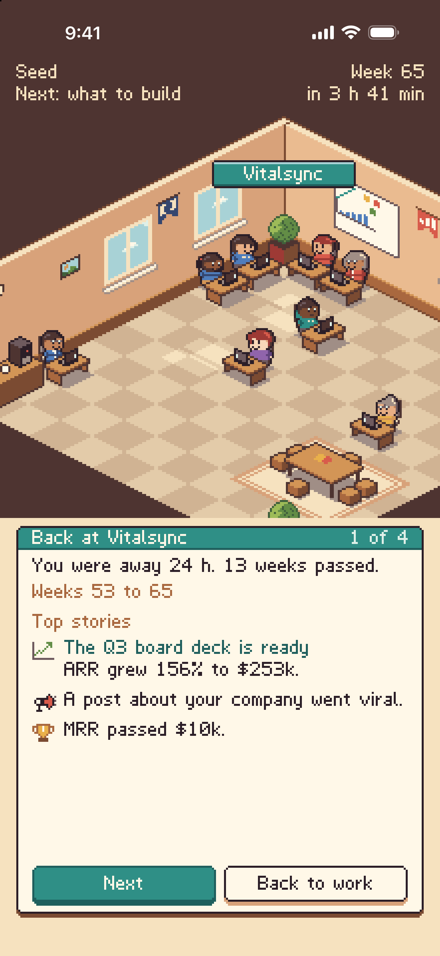
SpriteKit draws about 150 sprites in a full office, at 60 frames a second.
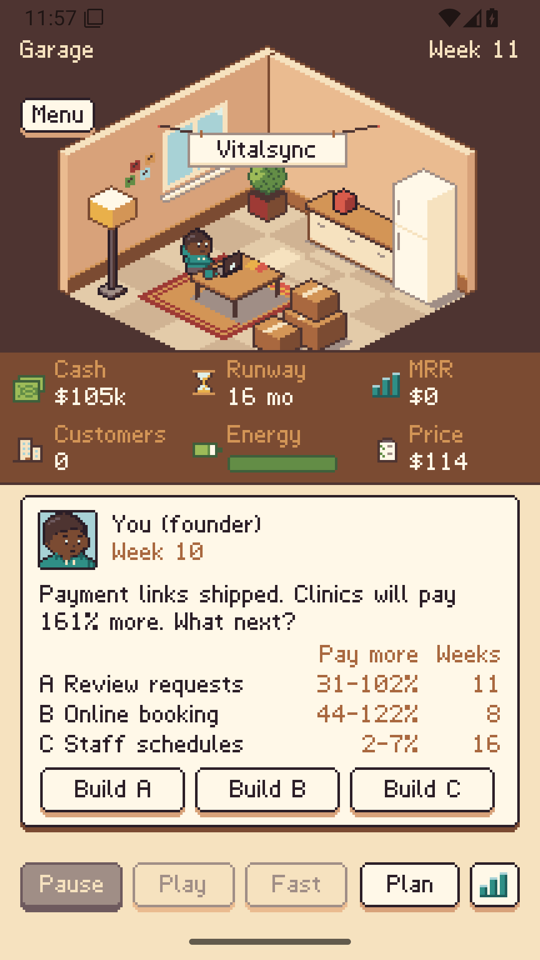
Swift draws the room at art size into one small picture, and Compose scales it up by whole pixels. In 18 of 18 test images it matched SpriteKit pixel for pixel.
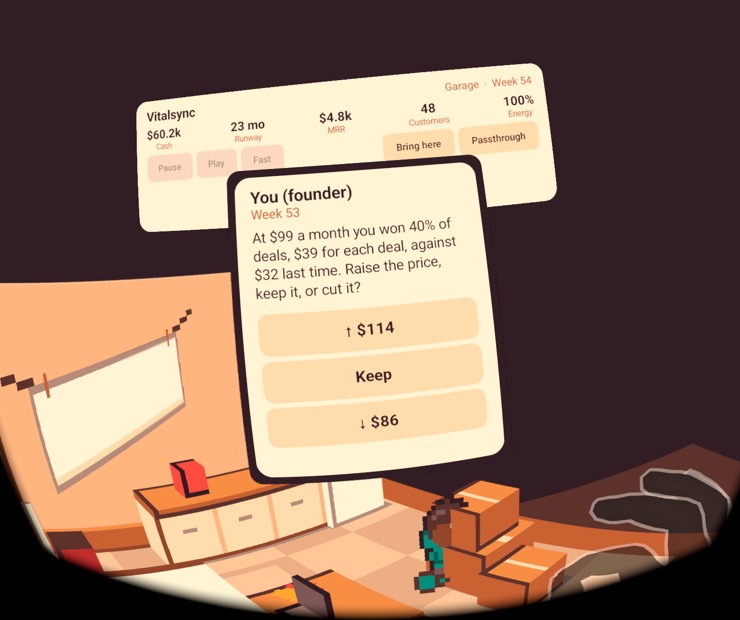
A Python exporter turns the same art code into a 3D model, a 31 KB glTF file. The headset draws it at 90 frames a second on a Quest 2. Captured on the headset on Oct 27, 2026.
Each person is a paper doll on a 16 by 24 pixel frame: legs, body, head, face, hair and what the hands hold, each drawn from a text grid. Rooms and furniture are boxes on a 2:1 isometric grid, lit from the upper left. One command builds every image, and two builds give the same bytes.
One tick is one game week
The clock runs in real time, so your company keeps working while you are away. Each week runs in this order.
- 1
 You decide
The price, who to hire, what to build and how much to spend on ads. Each judgment arrives as a decision card.
- 2
 The founder works
The founder spends the week's hours, 55 by default. Hours past 60 a week count half.
- 3
 The team builds
A shipped feature raises fit. Each week of building also adds tech debt, and debt lowers quality.
- 4
 Leads become deals
Channels bring leads. Leads become sales calls or free trials, depending on how you sell.
- 5
 Buyers decide
A deal closes only if the buyer will pay the price. A customer whose value falls below the price leaves fast.
- 6
 The money moves
Cash comes in and goes out, and a round may close. After the seed round the board meets each quarter, and the game writes the week's news.
Each buyer also gets a personal multiplier, drawn once and kept for life. A deal closes when that buyer's number beats your price. Price, churn, tech debt and talking to customers all run through this one equation.
The clinics segment ($1,200 a month at full value), with no rival in the market. The multiplier is lognormal with a spread of 0.7, as in the game.
A command-line lab plays scripted founders through the same core. If a strategy that breaks a lesson wins, the model is wrong, or the lesson is.
- Default alive or default dead
- Price is the strongest lever
- Churn beats slow acquisition
- Tech debt compounds
- Clear is kind
- Switching costs, not features
The core does its own math, so every phone gets the same numbers
Android's math library returned a different last bit than Apple's on some inputs. One different last bit can flip a chance draw, and then the company takes another path. So the core now computes exp, log, pow and cos itself, from a line-by-line Swift port of fdlibm, the open math library that Java's StrictMath is defined by.
of 1,200 test companies played out differently on Android than on the Mac.
of 1,200 differ. All 1,200 match the Mac bit for bit, and an Android build ships only after this check passes.
81% of the shipping code is Swift
59,214 lines ship in the three apps. Each line counts once, even when two or three apps use it.
lines in the shared core, the iPhone app and the Android Swift layer.
lines in the Android screens and the Quest app.
lines that build the pixel art and the 3D model. None of it ships.
lines of tests across the shared core, the iPhone app and the Android app.
One app is live, two are on the way
 Live
On the App Store since Oct 26, 2026. Free, with no ads and nothing to buy. Get it on the App Store
Android runs the same core as the iPhone. Tester sign-up for Google Play is open. Join the test
The garage runs in 3D with hand controls. Playable on a Quest 2 since Oct 27, 2026.